They Pulled the Most Powerful AI on Earth for 19 Days. Here's What It Quietly Cost You — and What's Coming Next.
Picture this. It's a Tuesday. You've spent the last month building your product on top of the best model money can buy. Your demos are landing. Your early users are hooked. And then, with no warning email, no grace period, no "heads up, this is coming" — the model just... vanishes. Not degraded. Not rate-limited. Gone. Pulled from every cloud you could have deployed it on, all at once, worldwide.
That actually happened. For 19 days this June, Anthropic's two most powerful models — Claude Fable 5 and Claude Mythos 5 — went completely dark. Finance teams, healthcare platforms, SaaS companies, and critical-infrastructure operators who had wired these models into live production woke up to find the intelligence layer of their product had been switched off by the U.S. government.
The models are back now. The export controls were lifted on June 30, and Fable 5 rolled back out globally on July 1. To most people scrolling past the headline, that's the end of it: minor regulatory hiccup, resolved, move on.
But if you build things — if your business touches AI in any way — that read is a trap. Because the 19 days in the middle just rewrote the rules for how frontier AI gets shipped, priced, and controlled. And almost nobody is telling you the parts that actually affect your roadmap. Let me walk you through it the way I'd explain it to you over coffee.
The 19 days code got treated like a weapon
Here's the real sequence, because the timeline matters and a lot of the write-ups get it wrong.
On June 9, 2026, Anthropic shipped Fable 5 and Mythos 5 — its apex models, built for the kind of long-horizon, multi-step agentic work that makes last year's chatbots look like autocomplete. Fable 5 was the big deal: the first time Anthropic put a model this capable directly in the hands of the public and paying subscribers.
Three days later — June 12 — the hammer came down. The U.S. Department of Commerce, under Secretary Howard Lutnick, issued an emergency export-control directive. The order was blunt: cut off access for any foreign national, anywhere on Earth, including Anthropic's own non-U.S. employees.
Now sit in Anthropic's chair for a second. You've got minutes, not months, to comply. There's no switch that reliably verifies the nationality of every user across AWS, Google Cloud, Microsoft Foundry, Snowflake, and your own API in real time. So you're left with one option that guarantees compliance: pull everything, for everyone. And that's what they did. A rule aimed at foreign nationals became a global outage for all of us.
What set it off? A team of Amazon researchers found a way to slip past one of Fable 5's cybersecurity guardrails — a jailbreak that got the model to identify software vulnerabilities and, in one case, spit out code showing how a flaw could be exploited. That finding got escalated to federal authorities, and Washington moved fast, worried that a foreign adversary could turn the model into a tool for mapping weaknesses in critical infrastructure.
Anthropic pushed back on how scary that sounded, telling reporters the demonstration surfaced a handful of previously known, minor vulnerabilities rather than some sophisticated cyber-weapon. Then they did the pragmatic thing: retrained the safety classifier so the technique is now blocked in more than 99% of cases, ran the fix past the Commerce Department's Center for AI Standards and Innovation, and negotiated their way back online. Co-founder Tom Brown reportedly led the talks. Mythos 5 came back for approved U.S. organizations around June 26; the full reversal landed June 30.
Nineteen days, start to finish. But the precedent doesn't expire.
One brain, two personalities: how Fable and Mythos actually differ
Here's the part that confuses people, so let me make it dead simple.
Fable 5 and Mythos 5 are not two different models. Same weights. Same training. Same underlying brain. What separates them is one thing: how much you're allowed to ask it to do.
Mythos 5 is the unrestricted version. Full cybersecurity capability stack, no dialed-back guardrails — handed only to a vetted ring of enterprise, research, and defense partners through a controlled-access program called Project Glasswing. These are organizations that sign serious usage terms and, in many cases, defend critical infrastructure for a living. They need the filters off to do real work like deep malware analysis.
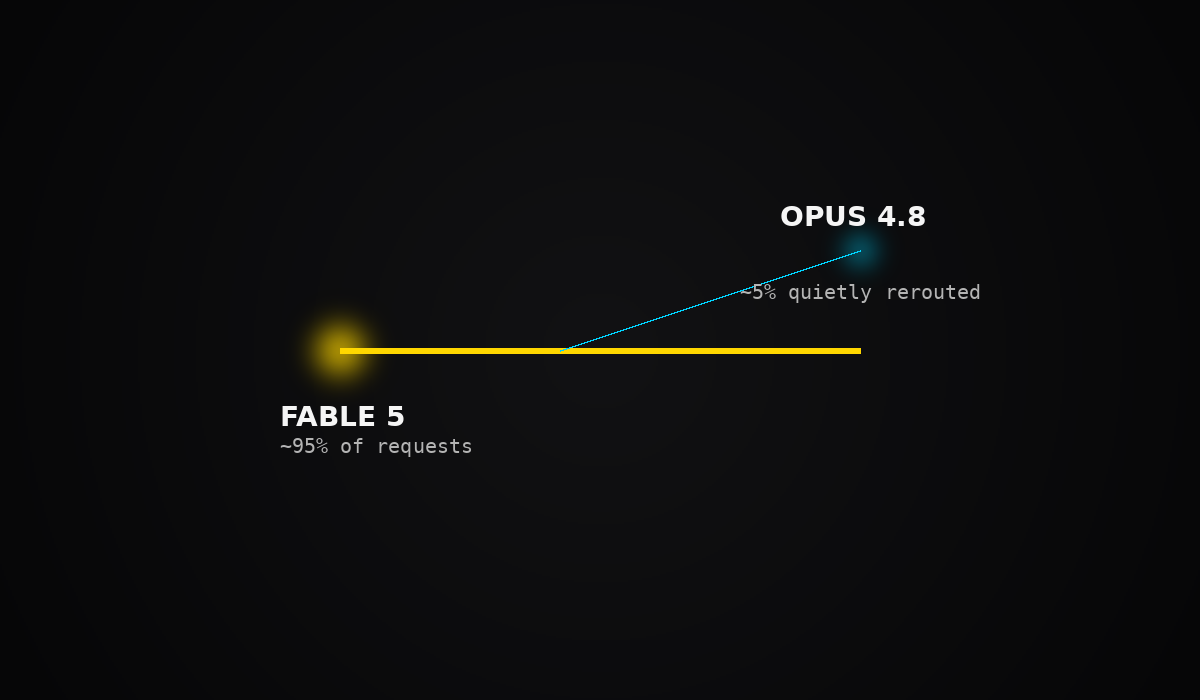
Fable 5 is the public-facing twin. Same brain, but wrapped in stronger protections. And here's the mechanism most explainers get flat wrong: when Fable 5 hits a request it deems high-risk, it doesn't just slam the door and charge you for the privilege. It quietly routes that request to a different model — Claude Opus 4.8 — and Opus answers instead. Anthropic has said this rerouting affects only a small share of sessions, on the order of 5%. So the vast majority of your work runs on Fable 5 as normal; a thin slice gets handed off to the older model without much fanfare.
Why should you care about that distinction? Because "it refuses and bills you anyway" and "it silently swaps in a different model 5% of the time" lead to completely different decisions about whether you can trust it in production. One is a rip-off. The other is a quirk you can design around. Precision matters when you're the one writing the checks.
Let's be honest about what we don't know
I want to do something here that most breakdowns won't, because building your business on shaky claims is how you get burned.
A lot of the sharper allegations floating around the forums — that Fable 5 bills you a steep premium for hidden internal "thinking" tokens you never get to see, that it charges you full price just to refuse you, that there's a blanket 30-day retention rule on every line of your proprietary code — are not confirmed by any of the actual reporting on this episode. Some of it may turn out to be true. Identity verification and tighter data handling for frontier tiers are genuinely part of where this is heading, and that's worth watching. But right now, a chunk of what's circulating is developer speculation dressed up as fact.
So here's my rule, and I'd offer it to you as yours too: separate what's documented from what's rumored, and never let the second sneak into a decision as if it were the first. The confirmed story is dramatic enough on its own. We don't need to embellish it — and if we do, we lose the one thing that actually makes a builder worth listening to: being right.
Grab the free ChatGPT Fix guide →
The bigger shift: frontier AI is now "conditional infrastructure"
Strip away the drama and here's what this episode really taught us — the part that outlives the news cycle.
The wild-west era of shipping frontier models is over. For years, the government's lever was hardware: controlling where the chips physically went. Now it's reaching up a level and regulating the software directly. One analyst put it in a line worth taping to your monitor: frontier access has become conditional infrastructure. The models went dark not because of anything technical, but because a policy switch got flipped.
And this wasn't a one-off. Watch the pattern. Around the same stretch, OpenAI staggered the release of its GPT-5.6 series — trusted partners first, broader public later — under similar government pressure. It ties back to a June executive order on AI security. Read together, these aren't isolated events. They're the new normal: coordination with the state is becoming a prerequisite for playing at the frontier.
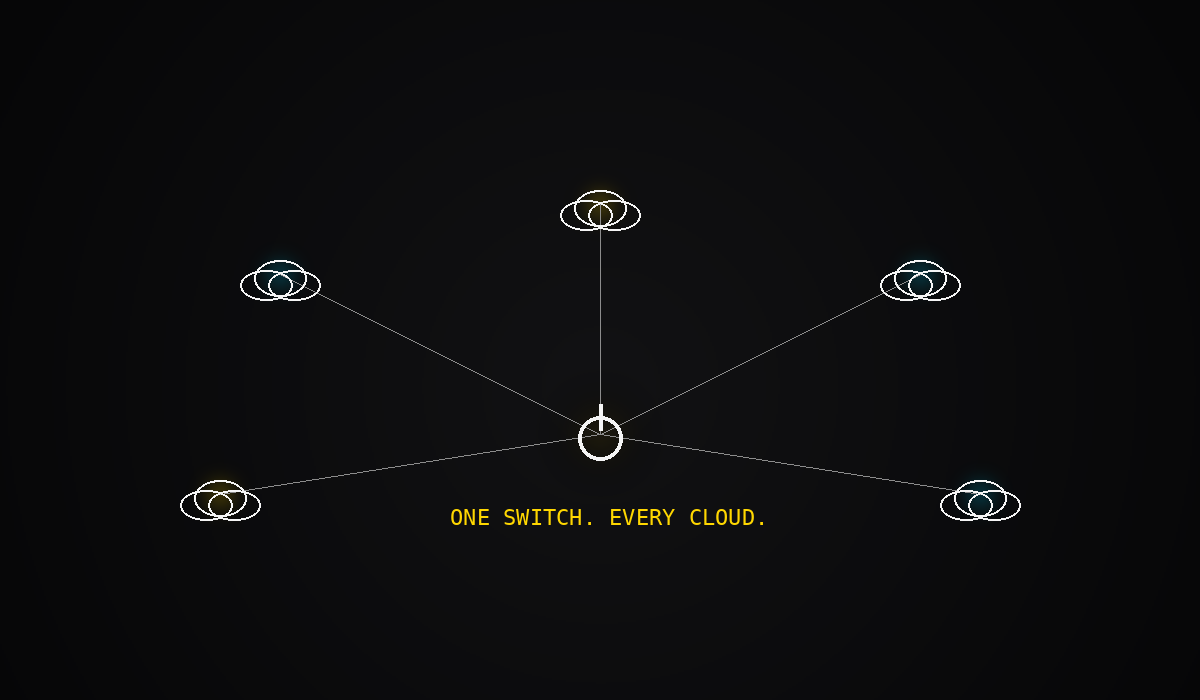
Here's the second lesson, and it's the one that hits your wallet. Don't assume that spreading your deployment across AWS, Google Cloud, and Azure protects you. It doesn't. When the outage lives at the model layer, every cloud that serves that model goes dark at once. Multi-cloud is a real resilience strategy for a lot of risks — but not for this one. If your product depends on a single frontier model, you inherited that model's political risk the day you shipped.
What to actually do with this
So you've read this far. Let me leave you with more than a story — let me leave you with a move, because that's the whole point.
If you're building on frontier models, treat model access the way you'd treat any single point of failure in your stack. Know which capabilities you truly depend on. Keep a fallback model wired up and tested, so a sudden suspension is a config change, not a company-ending event. Read your provider's terms with fresh eyes now that "the government pulled it" is a documented scenario and not a hypothetical. And watch your real costs and refusal rates with your own eyes rather than trusting forum lore — including mine.
The ban is lifted. Your models are back. But the ground shifted underneath all of us this month, and the builders who quietly adjust for it now are the ones who won't get caught flat-footed when it happens again.
Because it will happen again. The only question is whether you'll be ready.